Teaching
Coalition Game
For my course on Coalition Research, I developed a Shiny app that simulates electoral competition and coalition bargaining. Students take on the roles of political parties, choose ideological positions, and compete in an election in which voters support the party closest to their own preferences. Based on the resulting seat distribution, students negotiate a coalition agreement, including cabinet portfolios, the head of government, and a common policy position. A scoring system based on parties’ office-seeking and/or policy-seeking motivations (Strøm and Müller 1999) aimes to illustrate how different party goals shape coalition bargaining and its outcomes.
Feel free to use the materials. I’d be happy to hear about any experiences or further adjustments made.
Quantitative Methods
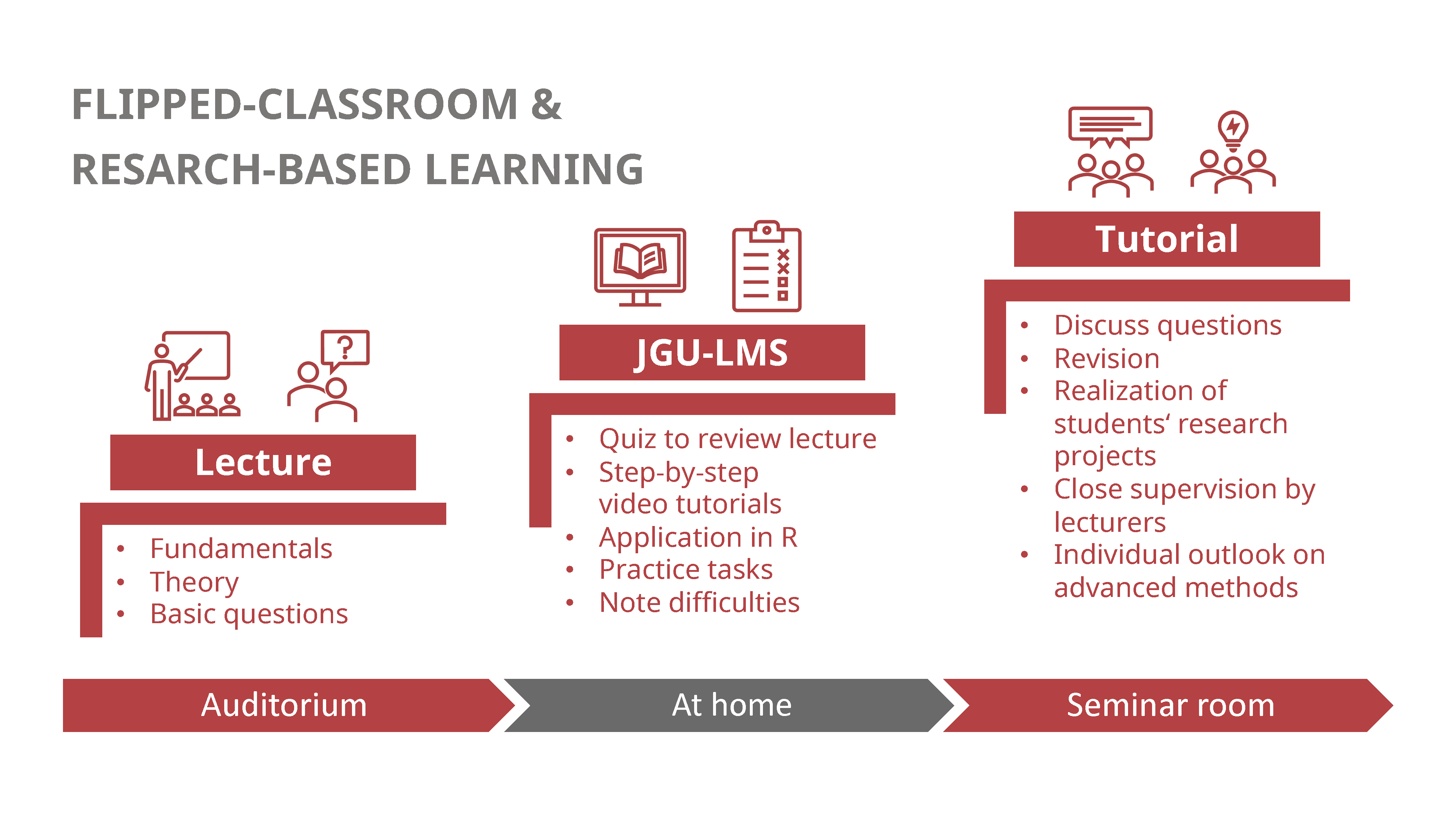
In response to the challenges posed by the COVID-19 pandemic, we (at the unit for Empirical Political Science) undertook a transformative teaching project: We moved away from traditional lecture-style teaching and textbook-based calculation exercises to a dynamic flipped classroom approach. Our primary aim is to equip students not only with basic computational and software skills, but also with a integral understanding of the research process: from research question to the communication of findings. In this way, students no longer learn from exercises set by lecturers, but by applying the new methods in small groups to research projects of their own choosing. The instructors act as advisors to the research projects and can provide individual assistance as well as outlooks on advanced methods. We think that such an approach encourages active student engagement and fosters a deeper understanding of the practical applications of methods in research contexts. The illustration below shows a typical working week for our students. Our project was funded by the Gutenberg Teaching Council at Johannes Gutenberg University Mainz.
Courses taught
Statistics I, since 2019 - 17 courses
Statistics II, since 2019 - 11 courses
Coalition Research, 2026
Coalitions in Comparative Research, 2022
Generalized Linear Models, 2020